The TrueType font format was developed by Apple Computer as an alternative to the Adobe Type 1 standard. It is used both on Macintosh and Windows computers.
Like PostScript Type 1 fonts, TrueType fonts also use outlines to describe the letter shapes.
TrueType fonts have the following characteristics:
- Their use is widespread and they are integrated in almost every desktop office software program for Microsoft Windows or Macintosh systems.
- TrueType fonts can print well on both non-PostScript and PostScript output devices. However, to print well on a PostScript device, the TrueType font must be converted to PostScript outlines, which may affect the visual quality of the resulting font. This is why many prepress service providers are reluctant to support TrueType fonts.
- On Windows-based systems, a TrueType font is physically stored in a single file, the name of which has the .ttf extension. On Macintosh, it is stored as a single Suitcase.
- A TrueType font is represented by the
 icon
in Windows environments and the
icon
in Windows environments and the  icon on a Macintosh operating system.
 - A TrueType font, or a combined use of TrueType and PostScript fonts in one document, may be troublesome in high-end PostScript devices, especially imagesetters.
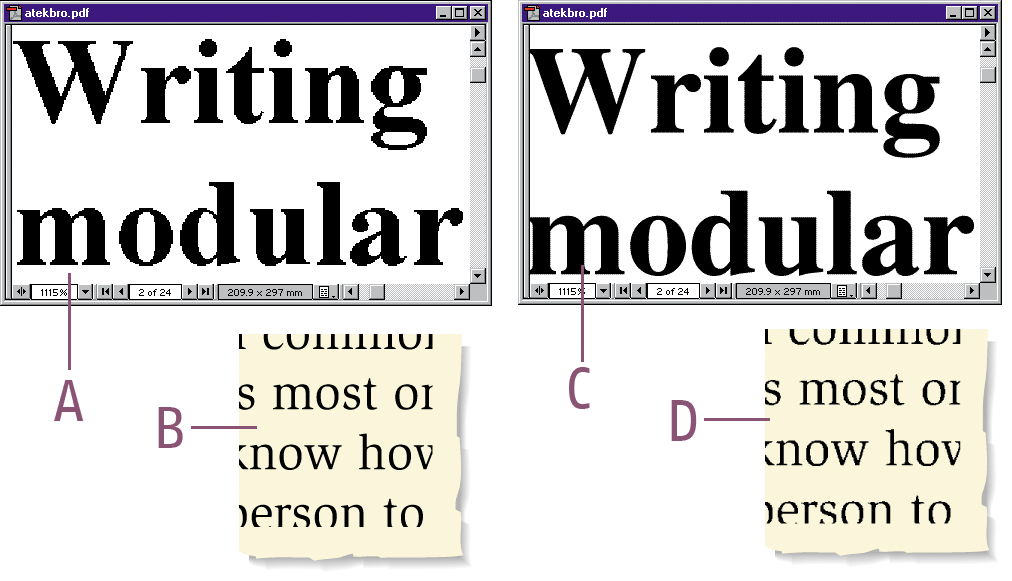
Times as PostScript Type 1 Single Master font on screen
Times New Roman as TrueType font on screen
Times as PostScript Type 1 Single Master font printed
Times New Roman as TrueType font printed